How to document a restoration while you are doing it
Updated
Two years of work, four thousand photographs on a phone, a box of receipts, and nobody who can tell what happened in what order. It is the normal ending of a restoration, and it is the reason a restored vehicle so often sells for the price of an unrestored one.
Why a service log is the wrong container
A service is a fact: it happened on a day, it cost an amount, it is finished. A restoration is a story with stages, dead ends, parts that arrive wrong and months when nothing happens.
Squeezed into a single maintenance entry with twenty photographs, the only thing that made it interesting disappears: the order it happened in. So a project gets its own place, above the service history rather than inside it.
Start with why, not with the first bolt
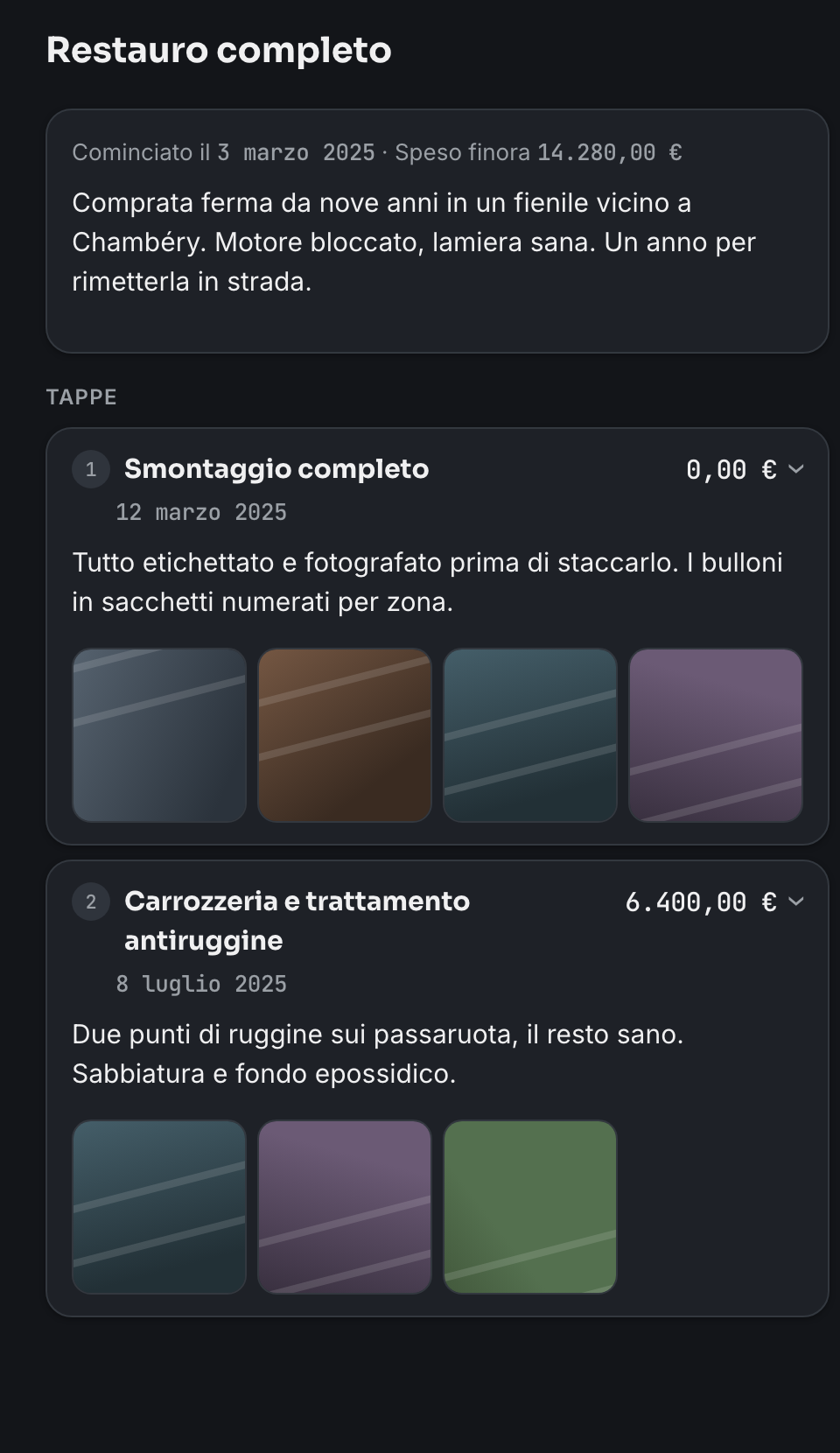
The opening text is not decoration. «Found sitting for nine years in a barn near Chambéry, engine seized, bodywork sound» is what makes everything that follows worth reading, and it is the one thing you will never be able to reconstruct later.
Write it on day one, when you still remember what the place smelled like.
Stages are chapters
Stripping down. Bodywork. Engine. Reassembly. Each stage takes a title, a few lines of what you did, a date, what it cost, and its photographs.
The order is yours, not the calendar's: a restoration proceeds in pieces, and some chapters get written in the middle. You can move a stage up or down at any time.
Everything stays editable while the work is in progress. A project is a diary, not a claim: it is meant to be rewritten as you go. What is immutable is the service history, and that is a different thing.
Photograph what is about to be closed up
Thirty photographs per stage, and use them. The inside of a sill before the panel goes back on, the crankshaft on the bench, the wiring loom laid out on the floor: none of it will ever be visible again, and all of it is what a serious buyer wants to see.
Photograph the ugly parts too. A restoration that shows only clean paint reads as a cover-up; one that shows the rust it started from reads as honest work.
Track what it costs while you spend it
Each stage carries its cost and the project adds them up. Not to justify a price to a buyer, which never works, but because you will want to know, and because reconstructing it two years later from a shoebox is impossible.
What you end up with
At the sale, a documented restoration is the difference between «it has been restored» and a story with dates, photographs and figures that anyone can read in five minutes.
And the structure is deliberately book-shaped: the opening text is a preface, the stages are chapters, the captions are captions. A printed book made from a project is a service we plan to offer, and when it arrives there will be nothing to reinvent.
Garage Saga keeps the project next to the service history of the same vehicle, so the story and the proof live together. It is free, and the whole thing passes to the new owner when you sell.
Create your free garage